

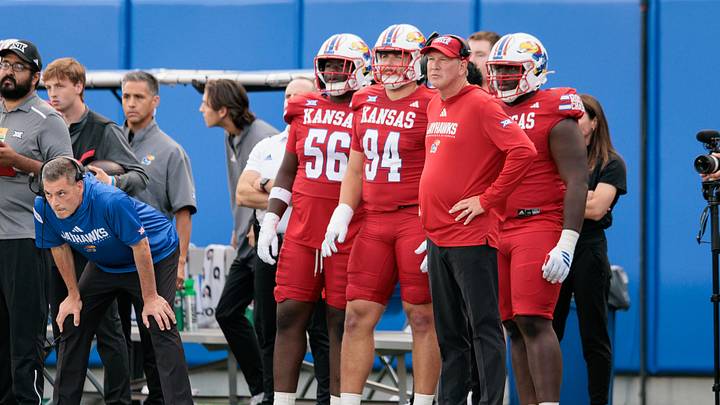
The Kansas Jayhawks are going to be dealing with a restructured offense next season under head coach Lance Leipold and returning associate head coach Andy Kotelnicki.
While there are several positions with varying degrees of questions over them, Kansas’ wideout core is near the top of that list.
Now, reshuffled wide receiving rooms are nothing new for Leipold. Heading into last season, Kansas raked in five new wideouts with Emmanuel Henderson Jr. eventually leading the way and making it to the NFL.
Now this season, Leipold and Co. are reeling in two more wideouts to fit in a crew of 13 total receivers.
Below is each wideout and their class
Donald Collier (Redshirt Sophomore)
Jackson Cook (Redshirt Freshman)
Bryson Hayes (Redshirt Freshman)
Tate Nagy (Sophomore)
Corbin Glasco (Freshman)
Tyren Parker (Freshman)
Nate Sims (Freshman)
Griffin Baker (Freshman)
Keaton Kubecka (Redshirt Junior)
Isreal Moses V (Redshirt Junior)
Cam Pickett (Redshirt Senior)
Nahzae Cox (Senior)
Nik McMillian (Redshirt Senior)
As you can tell, this is a core that is either way too young or way too old. For a quarterback battle that is still completely up in the air, expect the few upperclassmen who are there to get a majority of targets. But the question is, who will lead the way?
Pickett is not as clear-cut a WR1 as it may initially seem
Now, Pickett has topped several projections for wide receiving charts in the past. There is good reason for that. Last season, he finished with 45 receptions, 476 yards and three touchdowns on a 10.6 yards per reception average.
However, the likes of Cox and McMillian are intriguing options as well.
Cox reeled in 40 receptions for 473 yards and five touchdowns last season for an 11.8 yards per catch average for a Middle Tennessee side that finished 3-9 last season.
While Cox will likely challenge for second or third place, McMillian could easily top the receiving charts next season. For Buffalo last Fall, McMillian notched 981 yards in what resulted in an end-of-season sprint that saw him total 100+ yards seven times last season, six of those coming in Buffalo’s final six games of a 5-7 season.
The best thing Pickett offers over McMillian is continuity. While KU is bringing back Kotelnicki and letting him take charge of the playcalling, Jim Zebrowski remains and is now the team’s passing coordinator, meaning the experience Pickett has with the staff may be what pushes him over the line. However, we believe Cox will finish atop the charts when all is said and done.
Last season, Kansas finished with the nation’s No. 88 passing attack at just 211 yards per game, with Henderson leading the way with 766 yards through the air.
Against power conference competition last season, the Jayhawks finished 5-5 in terms of passing yards. KU ended up losing games against the Cincinnati Bearcats, Texas Tech Red Raiders and the Kansas State Wildcats, despite throwing for more yards. The latter two matchups ended in 42-17 blowout losses.
In order for the Jayhawks to get back to bowl eligibility and avoid three straight seasons without postseason football, KU has to post a strong wideout core, even if it comes under an unconvincing quarterback battle so far.
More Kansas Football News
 Add us as a preferred source on Google