

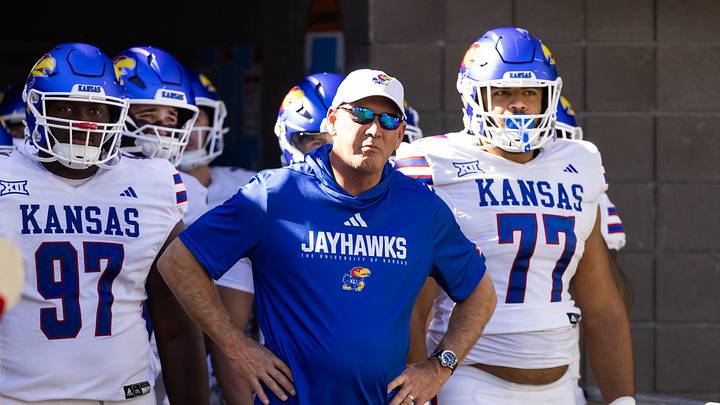
Last season, the Kansas football team continued a concerning trend.
You see, in the 2024 season, the Jayhawks lost four of their six one-possession games; those obviously played a big part in KU finishing with a 5-7 record.
Most were expecting (if not just hoping) the following year would see KU flip even one or two of those coinflips to ensure smooth sailing into another bowl season.
However, the Jayhawks played in four games last season that were within two scores; Lance Leipold and Co. went 1-4 in those games, with losses against Arizona and Cincinnati by a combined seven points. Of course, once again, the Jayhawks missed on a bowl game for the second time in two years under Leipold.
What caused these tight-knit losses?
There are several reasons why Kansas lost these games, but the most consistent thorn in the side was their red zone scoring rates.
It was something Leipold bit back on following Kansas’ narrow 37-34 loss to the Bearcats, saying, "Right now, offensively, we've got to be better in the red zone," Leipold said. "We are not scoring enough touchdowns in the red zone. We got a lot of touchdowns, and we got enough touchdown passes, but we got to be more efficient."
Things never really improved.
Following the loss to Cincinnati, Kansas was stamped with a 73.3% red zone conversion rate. Good enough for No. 105 in the nation.
Two wins and five losses later, and Kansas was sent to No. 124 in the country with a 71.79% rate.
In Kansas’ 24-20 loss to the Wildcats, Leipold and co. marked a 50% conversion rate inside the red zone. In the aforementioned loss to the Bearcats, Kansas notched a 75% conversion mark, and in Kansas’ season finale loss to the Utes, KU went just 2-5, measuring out to a 40% clip.
How do you go about fixing these crucial situations?
What makes this situation even more complicated is that there is no amount of work you can really do to replicate it in a practice setting. While practicing situational football is a must that every team employs throughout in-season practice, it is impossible to develop the rhythm necessary to get a real feel for in-game situations.
Red zone conversion rates were, funnily enough, not a problem in the 2024 campaign. Kansas finished No. 44 in the country with an 87.18% rate.
Next season, the Jayhawks will be bringing back the likes of former associate head coach Andy Kotelnicki, who is bound to help bring those numbers back to a stable place. In Kotelnicki’s last two seasons with the Jayhawks, Kansas reeled in rates of 87.27% and 81.82%.
It doesn’t help that Kansas is in the midst of a roster rebuild that is affecting every position on the pitch, especially on an offensive front that must now replace the likes of Jalon Daniels with an inexperienced quarterback room. In total, the Jayhawks welcome the likes of 31 incoming transfers and a freshman class of 18 newcomers.
More Kansas Football News
 Add us as a preferred source on Google