

The NIL era in college sports has changed the recruiting landscape, and some schools were slower to adjust than others. The Kansas basketball program did not have early success with NIL, and it's led to a slight fall from the top of the college basketball mountain.
KU has been hurt by some poor results from the transfer portal as well as with players they've recruited. Some of those players haven't been ideal fits for the program, others did not have enough support around them, and others still failed to meet expectations.
Kansas head coach Bill Self has just recently found his way through the murky NIL waters. After several failures early on, he's had more success of late, though not every player has paid off.
Kansas basketball's four biggest NIL failures
No. 4: Hunter Dickinson
The issues that accompanied Dickinson weren't all his fault. He certainly produced during his time at Kansas. Over two seasons, he averaged 17.7 points per game and 10.5 rebounds. The problem is he had little help.
He led the Big 12 in field goals attempted once, in two-point attempts twice, in two-point attempts made once, in defensive rebounds twice, and in total rebounds once. Despite these sparkling numbers, the Jayhawks struggled in Big 12 play and were ousted early during the NCAA Tournament.
Dickinson's first season at Kansas was marred by several players leaving the program that didn't appear to be expected. In his second season, Self's additions were poor system fits and never produced.
The program was also bogged down due to a few legacy players left over from the pre-NIL era who were unable to pick up enough slack to take more of the load from Dickinson's shoulders. His ranking here is less about his production and more about the failure for Self to surround him with better supporting players.
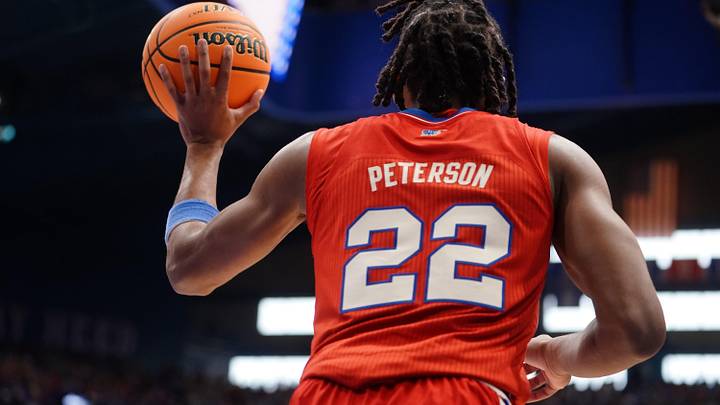
No. 3: Darryn Peterson
Peterson joined the Jayhawks as a highly sought-after, highly touted player with incredible expectations. When he played, he was extremely productive, averaging 20.2 points a game.
Something that no one could have predicted, however, were the issues Peterson would have with his health. He dealt with cramps and other issues all season. Those things limited him to just 24 games, and he had to leave several other games early.
Unlike with Dickinson, though, Self did provide Peterson with better supporting players, but his inability to play for much of the season prevented the team from fully meshing with their star on the court.
While NIL payouts aren't always fully disclosed, Peterson reportedly earned around $3 million last season. Whether that number is accurate or not, Peterson's injury issues held the team back, and KU probably didn't get their money's worth from Peterson. Last season was supposed to be a bounce-back season, but it fell short again.
No. 2: Rylan Griffen
Griffen was one of the players brought in as support for Dickinson, who didn't work out at all. Griffen averaged 11.2 points a game the season at Alabama the season before he came to KU, and he averaged 11.2 points at Texas A&M the season after he left KU.
While with the Jayhawks, Griffen averaged a measly 6.3 points for Kansas. He was a career 36.3 percent shooter from long range, but his 33.6 percent at KU pulled that average down.
His 37.2 percent shooting overall was also much lower than his career mark of 41.8 percent. The same pattern exists for his free-throw shooting, rebounds, assists, and steals. Griffen just wasn't the right fit at Kansas, and that falls on Self.
No. 1: AJ Storr
Storr, like Griffen, was expected to be a key piece on a team that would get Kansas back to its expected level of success. Like Griffen, Storr's time at KU was an utter failure that duplicated Griffen's pattern of non-production.
In his seasons before and after, Storr averaged 16.8 points and 15.5 points per game. In his lone season at KU, he only scored 6.1 points per outing. Like Griffen, only more drastically, Storr's shooting and rebounding also plummeted.
The two big transfers Self brought in for the 2024-25 season to help out Dickinson were utter failures. Between the two of them, they combined to score 15.6 points a game fewer than they did the previous season.
Because of that total lack of support, Dickinson's time was a failure at Kansas. The program did not use its NIL resources in a way that resulted in positive results for the university. In these three seasons, Kansas did not live up to its glorious history. Obviously, the Jayhawks did not gain the expected returns from the NIL investments. Hopefully, the program will improve in that area.
 Add us as a preferred source on Google