

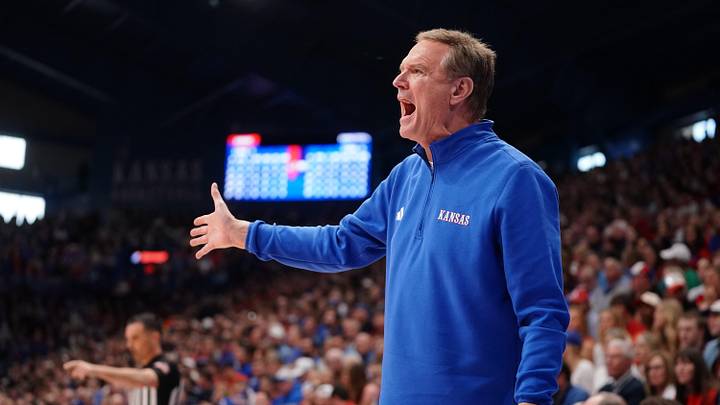
We are in a place where we can admit that the Kansas Jayhawks have fallen well below expectations since winning the national title back in 2022.
By no means have the Jayhawks been bad. Look at last season, there was a decent chunk where the Jayhawks were rightly deemed as one of the nation’s best programs. Wins against the No. 1 Arizona Wildcats, No. 2 Iowa State Cyclones and No. 5 Houston Cougars would do that. But when it came to crunch time, Kansas faltered. Something that has been steadily happening more and more since 2022.
It doesn’t help that Kansas will have to take on a roster rebuild that sees four new transfers in Dennis Parker Jr. (shooting guard), Leroy Blyden Jr. (guard), Keanu Dawes (power forward) and Christian Reeves (center).
And seven new freshmen incoming in Tyran Stokes (small forward), Taylen Kinney (point guard), Davion Adkins (forward/center), Trent Perry (wing), Luke Barnett (shooting guard), Grant Mordini (center) and shooting guard Atticus Richmond (small forward) all joining the program from the high school ranks.
Yet, when you look at what really caused Kansas’ issues from last season, the answer is simple. The Jayhawks had nowhere near enough depth to compete with the top dogs.
Last season, if it wasn’t Darryn Peterson, games would then rely on Illinois transfer Tre White or St. Bonaventure transfer Melvin Council Jr. The trio all had moments where they shone. Peterson finished the season with 12 20+ point games. White had marquee matchups in Kansas’ aforementioned win against Houston (23 points), Duke (22 points), finishing his sole season with five 20+ point games. While Council’s production is varied thanks to his high-risk, consistent drives to the rim against much taller opposition, even he had three 20+ point games.
The problem comes in with what happens when you get past those three and have to rely on an underdeveloped freshman, Bryson Tiller, and a Flory Bidunga whose skill set is much better utilized on the defensive end. Venturing past those two created even more questions with the likes of Elmarko Jackson, Jamari McDowell and Kohl Rosario often tasked with coming off the bench, where they each produced mixed performances.
However, head coach Bill Self and his staff have looked to fix those issues in a big way this offseason.
Kansas has greatly improved its depth to levels that can bring it back to contention
Last season, the Jayhawks bench rotation managed the nation’s No. 339 best bench offense, as Kansas notched just 13.09 points per game.
To be fair to Self, it is worth mentioning that Kansas consistently kept its rotations pretty short. Rosario, Jackson and McDowell were the only ones who you could guarantee would get minutes nearly every night. Backup center Paul Mbiya hardly saw the floor, same goes for freshman forward Samis Calderon.
But now with the introduction of Parker, Blyden, Reeves, Barnett, Perry, and Adkins, combined with the returning Mbiya and Rosario, there is suddenly a lot less pressure on Kansas’ starting five to notch the team’s majority.
Last season, Parker averaged 18.3 points, Reeves notched 11.1 and Blyden managed 16.4. Of course, all of those are coming in from non-power conferences, which means you wouldn’t be wrong to expect a downturn in their production, but there is at least production previously provided, unlike last season’s bench, which comprised largely of freshman or second-year players.
More Kansas Basketball News
 Add us as a preferred source on Google