

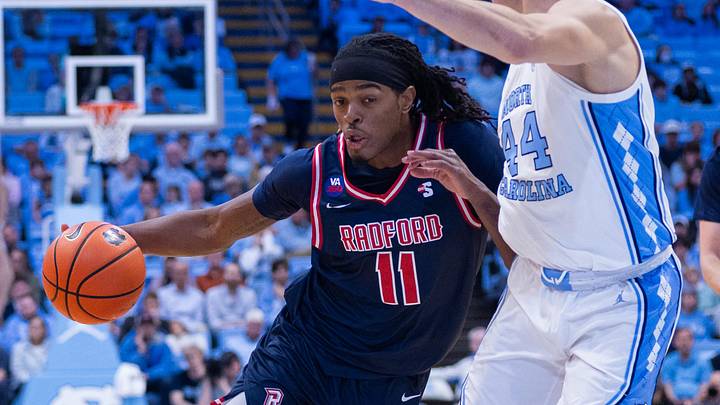
Bench scoring and production have been one of the biggest issues in this newest era of Kansas Jayhawks basketball since the 2022 National Championship. During that title season, KU had an elite bench scorer in Remy Martin that hasn’t been replicated since. However, Dennis Parker Jr. has the three-level scoring ability to be the best KU bench scorer since that Remy season.
Martin was initially a starter during that Jayhawks championship season, however he ended up coming off the bench in 17/30 games, recording 8.6 PPG in 21.1 MPG. Martin shot 46.2% from the field and 38.2% from beyond the arc. He also finished with 14 points (5/9 FGs, 4/6 3FGs) in his 21 minutes in the National Championship game against the North Carolina Tar Heels.
Following 2021-2022, the drop-off was somewhat dramatic for Kansas’ leading bench scorer:
2022-2023: Joseph Yesefu - 4.1 PPG (12.7 MPG)
2023-2024: Nicolas Timberlake - 5.2 PPG (15.4 MPG)
2024-2025: AJ Storr - 6.1 PPG (15.7 MPG)
2025-2026: Elmarko Jackson - 4.8 PPG (17.8 MPG)
Thankfully, Dennis Parker Jr. has the ability and opportunity to right the ship and become a “bench mob” fan favorite in Lawrence. He is coming off of his junior season, where he averaged 18.3 PPG and 5.9 RPG with the Radford Highlanders, including a 53-point performance in a 107-77 win over Coppin State.
While “strength of competition” is always a concern, Parker Jr. is not your typical small-school transfer. The 6’6” wing was a highly-touted 4-star recruit out of high school and also had some very good games last season against high-level competition. For example, he scored 18 points against SMU and 23 points against North Carolina, both of which were road games.
Who will Dennis Parker Jr. remind the KU faithful of?
Obviously, Martin and Parker Jr. are not similar in terms of size or style at all, however there are some very realistic player comparisons that Parker Jr. could show flashes of. The first is sophomore season Lagerald Vick (2016-2017). Vick and Parker Jr. have similar size profiles with Vick being a better shooter and Parker Jr. being a better rebounder and defender.
Vick came off the bench in 30 of 36 games for Kansas that season and averaged 7.4 PPG in 24.2 MPG. He shot 44.3% from the field and 37.0% from beyond the arc (Parker Jr. shot 48.4% from the field and 37.7% from beyond the arc last season).
The other player that comes to mind is sophomore-season Marcus Garrett (2018-2019). Garrett was more polished defensively than Parker Jr. likely will be, but the latter is much better on the offensive end, especially as a floor spacer. Garrett started just 13 of 30 games that season, but averaged 7.3 PPG in 27.9 MPG, so he had a very significant role for the Jayhawks that year.
Parker Jr. likely ends up as a hybrid of these two former Jayhawks. It would be surprising if he sees as many minutes as either sophomore-year Vick or sophomore-year Garrett, however, the 7.3-7.4 PPG output is something that feels achievable if he gets off to a hot start at the beginning of the season.
Looking at the KU depth chart, Parker Jr. will slot in at backup SG/SF with an opportunity to play small ball PF if needed. Not only that, but he has a chance to be the first man off the bench, pending how Kohl Rosario is looking and if any of the backup bigs can make a strong impression on Bill Self. Only time will tell if Parker Jr. can be KU’s first 7+ PPG bench scorer since Martin.
More Kansas Basketball News
 Add us as a preferred source on Google