

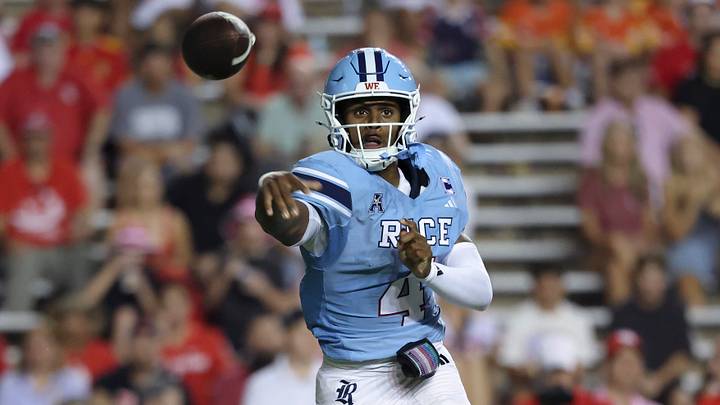
The Kansas football team has one overwhelming decision to make this year during the preseason. Who will be the starting quarterback for the Jayhawks?
With Jalon Daniels now gone to the NFL, there is a massive void at quarterback. KU doesn't have much experience at that position. Chase Jenkins, a senior transfer from Rice, doesn't have a large amount of experience, but more than Cole Ballard and Isaiah Marshall, the two returning Jayhawks with some snaps on their resume.
Jenkins shares some similar skill sets as Ballard and Marshall, but he also surpasses them in other areas. While all three can create positive yards with their legs, Jenkins isn't as effective as the other two. He might, however, be a better passer, at least on shorter routes.
How might Chase Jenkins contribute to the 2026 Kansas football team?
Jenkins' biggest strength might be his passing accuracy. He completed 68.4 percent of his limited 19 chances as a freshman before switching to wide receiver at Rice. When returned to quarterback last year as a junior, he proved that level of accuracy wasn't a small-sample-size fluke. He completed 69.2 percent of his 172 attempts. That's pretty good.
By comparison, Ballard has thrown just 64 passes in limited opportunities in his three seasons at Kansas but completed just 54.7 percent of those attempts. Marshall's sample size isn't robust enough to read anything into it, but he is 3-for-3 on his passes.
Only so much can be gleaned from stats on paper without watching game film, but one thing is concerning about Jenkins' passing numbers. He's only averaged 8.5 yards per catch on his 132 completions.
Ballard, on the other hand, with a much smaller sample size of 35 completions, averaged 12.7 yards per completion. Several things could affect those numbers, especially the style of offense. Jenkins may not have been asked to throw deep often, or maybe his receivers at Rice weren't effective at gaining yards after catches.
It will be interesting if Jenkins can increase that stat in the KU offense or if he is limited by his arm strength. If that is the case, he may not make as big of a contribution to the offense as is hoped.
At Rice, Jenkins got plenty of opportunities to run the ball. He had 166 carries at Rice but only 615 yards. That's an average of only 3.7 yards per carry. Again, that could be a result of the offensive scheme if the Owls called runs for him.
On 40 career carries, Ballard is averaging a much better 5.2 yards per carry, and Marshall's numbers are even more dynamic. As a redshirt freshman last season, Marshall averaged 10.7 yards per attempt on 15 carries. Most of his opportunities came on called plays designed for him, but he's shown a dynamic ability to run the ball.
Ballard might have the inside track due to his experience in the system, but Marshall might be the fan's choice if he can earn the role. Jenkins, however, offers the experience and the basic skill set to step in and possibly grab the starting role himself.
Maybe the biggest issue for Jenkins is that he is dealing with a knee injury, and if that isn't fully healed in a month, it will be difficult for him to have enough time to prove himself. It seems unlikely he can overtake the other two candidates if he is held back for any length of time by this injury.
This will be a very intriguing positional battle in camp, and it appears that any one of the three could win the starting quarterback role. Jenkins may surprise some people. We shall see.
 Add us as a preferred source on Google